
Physics Of Sound
Sound is created by pressure variations that move in waves
through a medium such as air or water. It is measured in terms
of frequency and amplitude.
Frequency
Measured in hertz (Hz)
The number of times per second that a
sound pressure wave repeats itself.
sound pressure wave repeats itself.


AMPLITUDE
Measured in decibels (dB)
The relative strength of sound waves,
which we perceive as loudness or volume.
which we perceive as loudness or volume.

Threshold of human hearing

Volcano
crater (Haleakala National Park)
crater (Haleakala National Park)

Leaves
rustling (Canyonlands National Park)
rustling (Canyonlands National Park)

Crickets
at 5m (Zion National Park)
at 5m (Zion National Park)

Casual speech
at 5m (Whitman Mission National Historic Park)
at 5m (Whitman Mission National Historic Park)

Motorcycle
at 30m (Yellowstone National Park)
at 30m (Yellowstone National Park)

Thunder (Arches National Park)


Military jet
at 100m AGL (Yukon-Charley Rivers National Park)
at 100m AGL (Yukon-Charley Rivers National Park)

Cannon fire
at 150m (Vicksburg National Military Park)
at 150m (Vicksburg National Military Park)
Decibels
A small change in decibels means a big change in loudness.
That’s because decibels work on a logarithmic scale. An
increase of 10dB represents
a ten-fold increase in sound
level, which causes perceived loudness to double.
| Decibel Level | Sound Level/Intensity | Perceived Loudness |
|---|---|---|
| 20 dB |   100 (102) 100 (102) | 2 |
| 30 dB | 1000 (103) | 4 |
| 40 dB | 10000 (104) | 8 |
If 1 vacuum cleaner measures 70dB than 80dB equals 10 vacuum cleaners.
How Sounds Travel
Propagation
How a sound wave travels outward from the
source, through a medium, like air or water.
source, through a medium, like air or water.
Noise levels in park transportation corridors today are at 1000 times the natural level.

*For illustrated purposes only and not an accurate
representation of scale.
Road noise impacts on wildlife have been shown to extend over a mile into the forest (Brumm 2004).

*For illustrated purposes only and not an accurate
representation of scale.
Key Words
ACOUSTIC RESOURCES
Physical sound sources including natural sounds (wind,
water, wildlife, vegetation) and cultural and historic
sounds (battle reenactments, tribal ceremonies, etc).
SOUNDSCAPE
The human, or animal, perception of all combined acoustic
resources.
ACOUSTIC ZONES
Areas with similar vegetation, terrain, animals, and weather
likely have similar acoustic characteristics, including
sound sources and sound characteristics. Acoustic zones may
be based on existing management zones.
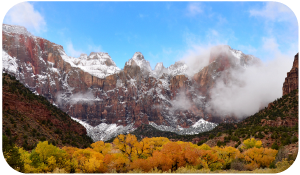
Zion National Park has different 7 unique Acoustic Zones
NOISE FREE INTERVAL
The period of time between noise events, during which no
human-cause sounds are audible.

In a transportation
corridor, the noise free
interval can be as small as
seconds 30 during high traffic times!
corridor, the noise free
interval can be as small as
seconds 30 during high traffic times!